
Rockford City Directory Holdings
Rockford city directories survive across several custodians rather than one complete digital run. Rockford Public Library Local History provides direct scans and in-library databases. The Winnebago County Historical Society inventory extends selected printed and microfiche years into the late twentieth century. Edition formats change, so the year, publisher, and access channel should accompany every citation.
| Collection | Years | Where Held | Access |
|---|---|---|---|
| RPL digitized city directories | 1857, 1869, 1880 | RPL Local History | Free PDF scans |
| Ancestry Library Edition run | Rockford 1869–1960 | RPL | In-library database |
| WCHS selected directory run | 1856–57 through 2001 | WCHS local-area collection | Physical or microfiche; years vary |
| Reverse and cross-reference | 1903–04 onward; 1987 Hill-Donnelly | RPL, WCHS, Ancestry | Street-to-name access by edition |
| County telephone directories | Selected 1945–1961 | WCHS | Physical collection |
No official source identifies the final printed Rockford edition, and scan status varies. Treat an absent year as a collection gap until staff confirm it, not proof that the person left town.
Three Digitized Rockford Directories
The RPL scans offer three strong starting points. The 1857 Rockford City Register uses many intersections and relative locations. The 1869 Kauffman and Burch directory is also a county gazetteer and includes occupations, firms, house numbers where available, and boarding clues. The 1880 Matthews directory more often gives a numbered residence.
Search text can miss old type, initials, and spelling variants. Browse the alphabetical pages near the expected surname and save the title page, abbreviation page, entry page, and PDF page number. Swedish and other immigrant names may shift between initials, anglicized given names, and phonetic spellings.
The 1869 sample for C. C. Kauffman shows the directory publisher boarding at Holland House. It warns against reading every address as a family home. A business, hotel, boarding place, and residence can appear in one alphabetical sequence, and only the edition's wording identifies the role.
Rockford's Local History Room
RPL's Local History Collections and Archive are part of Adult Services at 215 N Wyman Street. Staff can be reached at 815-965-7606 or localhistory@rockfordpubliclibrary.org. Beyond directories, the collection includes Rockfordiana clippings, maps, cemetery material, yearbooks, local vital indexes, newspapers, and the Andrew M. Potter Civil War collection.
The RPL digital local-history site shows the archive and research-assistance channel.
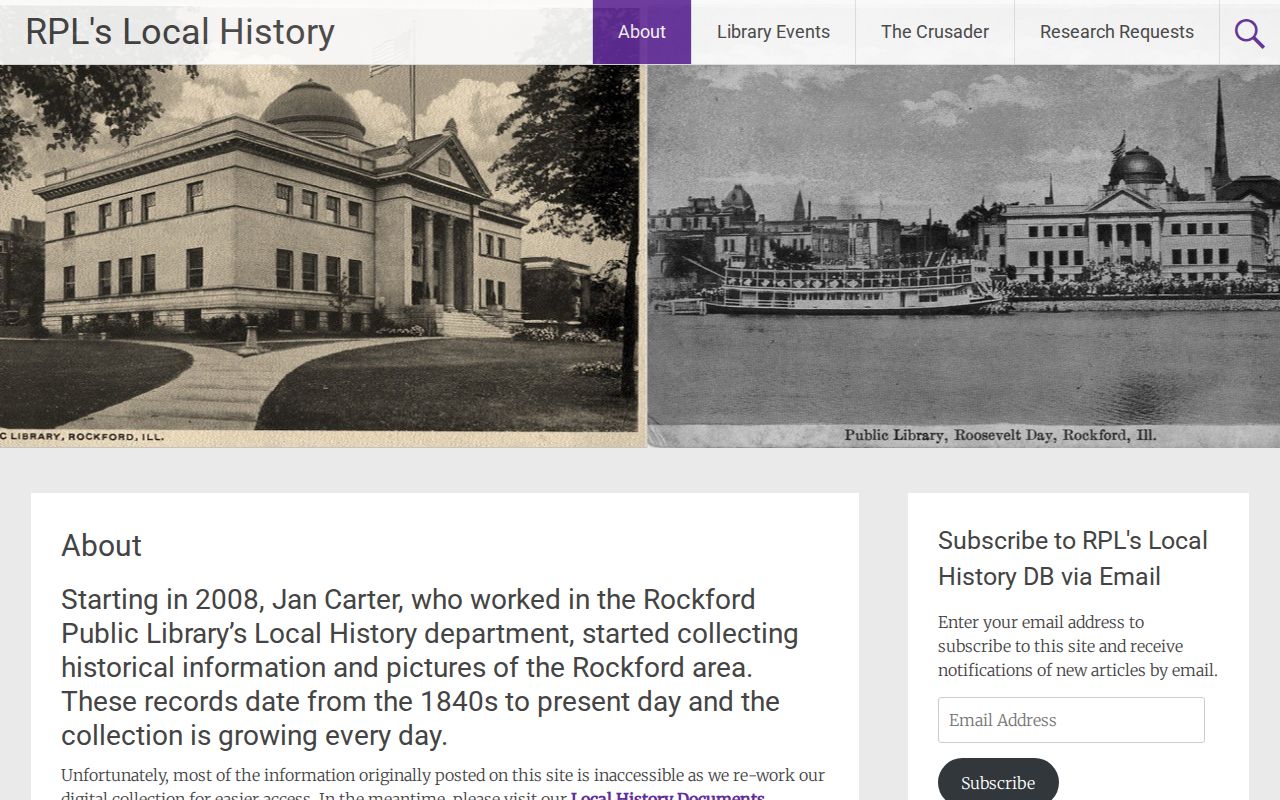
Digital reproductions are available for research consultation and scholarly use. Further distribution or commercial reuse requires permission.
Read a Rockford Directory Entry
A city directory entry is a compact, dated statement. The 1857 edition may give origin and years in Rockford as well as an occupation and relative street location. In 1869, a person may be shown boarding at a hotel. By 1880, numbered residences are common enough to support a closer map match.
| Name | Surname, given name or initials; spelling may change |
|---|---|
| Work | Occupation, employer, firm, or role such as publisher |
| Location | House number, street, intersection, side, or relative place |
| Status code | Residence, boards, house, widow or wife notation, depending on edition |
| Extra detail | Origin and years in Rockford may appear in the 1857 run |
- Criss-cross directory
- A later address-first section arranged by street and number rather than surname.
- Householder index
- An address-based list of named household heads or primary listings, with coverage rules set by its publisher.
- Abbreviation key
- The edition's code list. Save it before interpreting words such as res., bds., cor., nr., or opp.
One observed 1880 entry lists Peterson John, a shoemaker, residing at 501 S. Seventh. Another lists publisher W. F. Matthews at 1008 Peach. These examples show the name-work-address pattern, not title ownership.
Rockford Directories Turn Street-First
The Rockford Historic Preservation Plan identifies 1903–04 as the first reverse directory by street, with reverse components in later editions. That shift changed research from person-to-address into address-to-name. The 1987 Hill-Donnelly cross-reference directory provides a later Rockford and Loves Park bridge.
| Year | Directory milestone |
|---|---|
| 1857 | Digitized register uses intersections, origins, and years in Rockford |
| 1869 | Kauffman & Burch city directory and county gazetteer |
| 1880 | W. F. Matthews edition with many numbered addresses |
| 1893 | Street renumbering creates a pre/post address break |
| 1903–04 | First reverse-by-street directory identified in the city plan |
| 1987 | Hill-Donnelly Rockford/Loves Park cross-reference |
Philippi's 1890 Rockford Blue Book also reverses by street, but it was limited to a selected social group. It is not a full roll of Rockford residents.
Publishers Across Rockford Directory Years
The WCHS inventory fills many years between RPL's scans. It lists L. P. Philippi in 1894–95, Republic Company in 1902 and 1903–04, McCoy Directory Company in 1909–10, 1912, 1919, 1925, and 1928, Durfro Company in 1933, and R. L. Polk in selected years from 1942 through 2001.
Access begins with the Winnebago County Historical Society collection inventory. Confirm the exact volume and reading arrangement before visiting. The list also includes telephone directories for Cherry Valley, New Milford, Rockton, and Winnebago in selected years. Subscriber data adds a dated clue but does not prove occupancy.
Note: A publisher change may alter abbreviations, coverage, and street-order sections, so cite the edition rather than treating the run as one database.
Rockford's 1893 Address Break
The city changed street numbers in 1893. An 1880 house number cannot be carried straight onto a modern parcel without a bridge. Earlier city directory entries may say “cor.” for corner, “nr.” for near, “opp.” for opposite, or “bet.” for between. Those words define a street segment when no number exists.
Pair the entry with an 1866, 1871, 1872, 1892, or 1905 atlas, a Sanborn fire-insurance sheet, a plat, adjacent names, and the next directory edition. Keep east and west directions because the Rock River shapes Rockford's address geography. The Rockford Historic Preservation Plan is the main local chronology for the renumbering and reverse-directory transition.
Pair Rockford Directories With Archives
RPL's NewsBank access reaches the Rockford Register Star newspaper family back to 1871, under several title variants. HeritageHub supplies obituary and death-notice searching, while HeritageQuest gives census access. Rockford High School yearbooks begin with an 1892–1917 run and later material. These sources can explain a move, death, marriage, school link, or changed name seen between editions.
Local vital indexes at RPL cover deaths from 1844–1981, births from 1855–1931, and bride and groom marriage indexes spanning 1835 or 1836 through 1956. They are finding aids. Certified records remain with the Winnebago County Clerk or Illinois Department of Public Health under eligibility rules.
Newspaper title changes matter too. The library lists the Daily Register, Daily Register-Gazette, Morning Star, Register Star, Register-Republic, Republic, Rockford Journal, and weekly Gazette variants. Search the same name and date across likely titles, then confirm a relationship with a directory, census, obituary, or vital index.
IRAD's Winnebago County holdings add deed books, court and probate series, census material, WPA board minutes, farm-name registers, and city reports. The depository is at Northern Illinois University in DeKalb, so historical access may require a repository request or visit rather than a courthouse web search.
Request Missing Rockford Directory Pages
When an edition is not scanned, use the RPL Local History request form. Supply contact information, the person or institution, record type, event date, and any known address. Obituary requests can include the newspaper, page, and title. Results may be sent by scanned email or physical mail.
Research is prepaid at $15 per hour or portion. The current web page says no more than three forms per week, while the PDF says one form with up to three requests per week. Ask library staff which limit controls before submitting. This discrepancy is more useful than assuming an outdated form rule.
FamilySearch adds an online early-marriage book for 1836–1866 and a cataloged 1836–1850 index. Its Illinois births and christenings collection covers 1824–1940, with privacy limits on recent records. Search the place as United States, Illinois, Winnebago and note whether an item is online or repository-only.
Trace Family Through Rockford Directories
A Rockford city directory works best as one dated frame in a longer family trail. Start with a known name, year, or address. Keep variants and initials in the search log, and never treat a missing entry as proof of death or departure.
- Search the nearest city directory year. Read its abbreviation key and copy the complete entry.
- Move to earlier and later editions. Note each address, firm, occupation, spouse or widow code, and boarding label.
- After 1903–04, check the reverse section for the address. Before 1893, bridge the old location with maps and intersections.
- Compare public census households at decade points, accounting for ward, township, and the federal release rule.
- Use newspapers, obituaries, yearbooks, cemetery indexes, vital indexes, or probate to explain a gap. Verify title separately in property records.
A disappearing person may have moved, died, changed a name, been omitted, or lived outside the publisher's coverage. For a current address-keyed search, use the Rockford street directory workflow instead of extending a historical listing into the present.